
How Long Structural Drying Takes—and How You Know It Is Done
The honest answer is usually “several days, confirmed by readings.” Here is why some assemblies dry quickly, others stall, and a dry-looking wall may not be ready to close.
Written and operationally reviewed by the Emergency Restoration team.
Published 2026-08-03 · Updated 2026-08-03 · 7 min read
01
Several days is common; a fixed promise is not
Straightforward clean-water losses are often measured in days rather than weeks. That does not make “three days” a rule. A concrete slab, plaster wall, hardwood floor, insulated cavity, and open wood framing can all begin wet on the same morning and reach acceptable conditions at different times.
A contractor who promises an exact finish before measuring the materials is promising a calendar, not a drying result. The better question is: what is wet, what is the dry reference, how will progress be checked, and what will happen if a material stalls?
02
Five conditions usually control the schedule
Drying is the movement of moisture from the material into the air and then out of the drying environment. Anything that restricts that movement can extend the job. The source must also be fully controlled; no equipment plan can overcome water that is still entering.
- Material: dense or layered assemblies release moisture differently from exposed framing.
- Extent: water across several rooms and levels requires more capacity and monitoring points.
- Access: paint, flooring, cabinets, insulation, and vapour layers can restrict evaporation.
- Environment: temperature and humidity affect what the air and equipment can do.
- Contamination: some porous material should be removed rather than dried in place.
03
The first visit establishes the map
The starting record should identify the source, visible damage, affected material types, moisture boundaries, environmental conditions, and dry reference areas where possible. Photographs show the room; readings show what the photograph cannot.
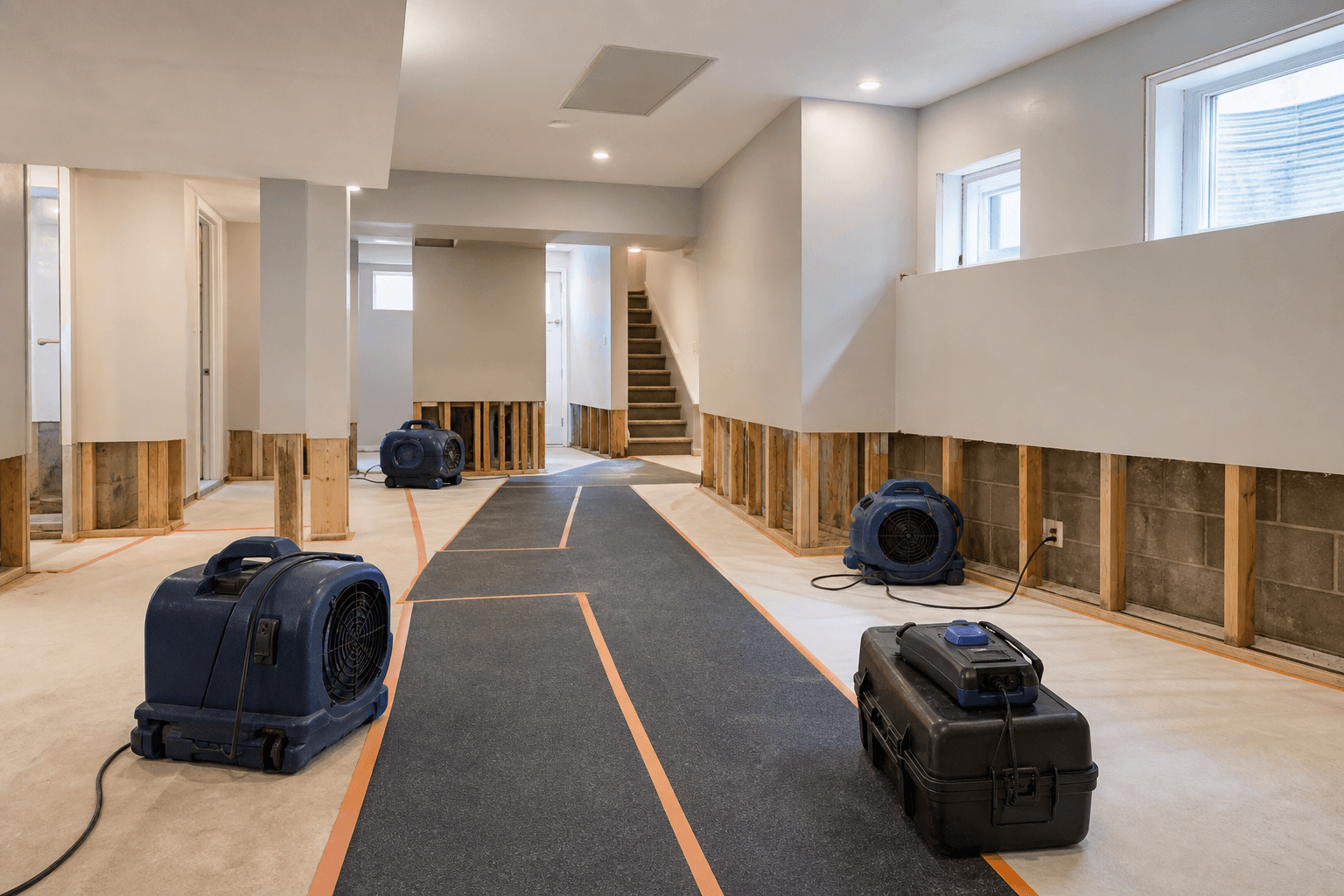
Equipment is then placed to create evaporation at wet surfaces and remove moisture from the air. Closed doors, containment, floor protection, and safe cable routes may be part of the setup. The plan should fit the building rather than blocking exits or creating unnecessary disruption.
04
Monitoring is where a drying plan proves itself
At monitoring visits, readings are taken at repeatable points and compared with the starting condition and dry goal. Air movers may be moved as one area improves. Dehumidification capacity may be changed. A hidden cavity may need access if surrounding material remains wet while the room air improves.
Progress should be explainable. “The machines have been here for four days” is not the same as “these wall plates moved from the starting condition toward the dry reference and are now stable.”
05
Why drying can stall
Common causes include an ongoing plumbing or envelope leak, wet insulation behind drywall, moisture trapped below flooring, limited airflow, an equipment problem, unusually cool conditions, or a material that is too damaged to save. A stalled reading is a reason to investigate, not simply a reason to leave everything unchanged.
Sometimes the least destructive plan at the start changes after monitoring. A small access opening or selective removal can be more responsible than running equipment against a sealed assembly with no result.
06
Drying is complete when the file and room agree
The closeout should identify the final material condition, what was removed, what remained, and which repair work follows. Equipment can then be removed without leaving an unexplained gap between mitigation and reconstruction.
The room may still need drywall patches, paint, trim, flooring, or cabinets. That does not mean drying failed; it means emergency restoration and finished reconstruction are different stages. Keeping both stages in one documented scope makes the transition easier to understand.
Sources and limits
Official references checked for this guide
- IICRC — ANSI/IICRC S500 water damage restoration standard overview
- City of Toronto — Basement flooding safety information
This guide is general property-restoration information, not legal, insurance, medical, electrical, or engineering advice. Conditions and program rules can change; confirm decisions with the relevant authority and qualified professional.